Beginnings
Nemadji Tile and Pottery starts in Moose Lake, producing tile from Minnesota clay.
A Minnesota original
Colorful, affordable and endlessly individual, Nemadji has inspired generations of collectors. Here is a practical introduction to its real history, identification clues, special lines and care.
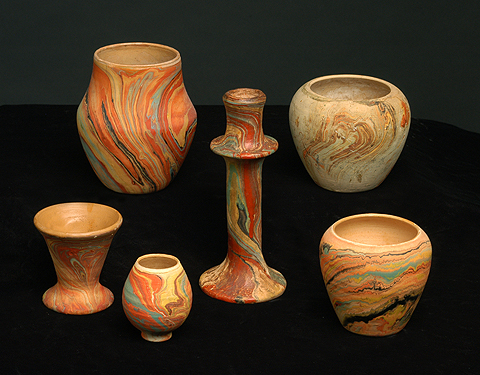
1923–2002
Nemadji Tile and Pottery began in Moose Lake, Minnesota, in 1923. During the Depression, the company expanded into decorative pottery for the tourist trade. Eric Hellman developed the distinctive cold-painted swirl process in 1929 and created early master molds that influenced decades of production.
Pieces were made in Moose Lake and later in nearby Kettle River. The plant closed in 2002, leaving a remarkable eight-decade record of changing clays, forms, marks, finishes and creative experiments.
Nemadji Tile and Pottery starts in Moose Lake, producing tile from Minnesota clay.
Designer Eric Hellman introduces the cold-painted process associated with Nemadji’s signature look.
Decorative pottery grows from economic necessity and reaches tourist markets around the country.
Production ends, but the hunt, the scholarship and the collector community continue.
What collectors should know
A bottom mark can be helpful, but it should never be the only evidence. Clay color, shape, construction, paint, interior treatment, finish and provenance all belong in the conversation.
Arrowhead, Native American profile and other printed marks can suggest a period. Some authentic pieces are unmarked, and marks may be faint.
Nemadji used local red clay as well as buff clay associated with Wrenshall. Clay color is a clue—not a verdict.
Forms were fired, then decorated with oil-based colors using the distinctive cold-painted swirl technique.
Chips, cracks, repairs, paint loss and interior finish affect desirability. Age alone does not determine value.
Demand, rarity, age, condition and buyer preference all matter. Completed sales are more useful than ambitious asking prices.
Nemadji remains approachable. The colors, forms and memories attached to a find are part of its value.
Beyond the familiar swirl
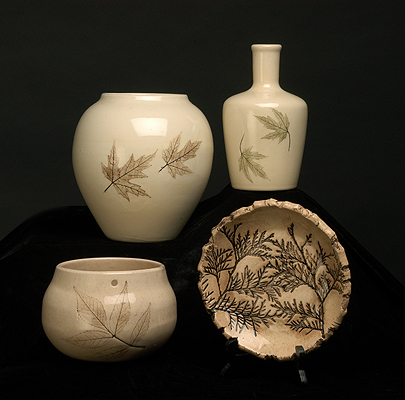
A labor-intensive, limited-production line from the early 1980s. Its textured natural motifs make it especially interesting to collectors.
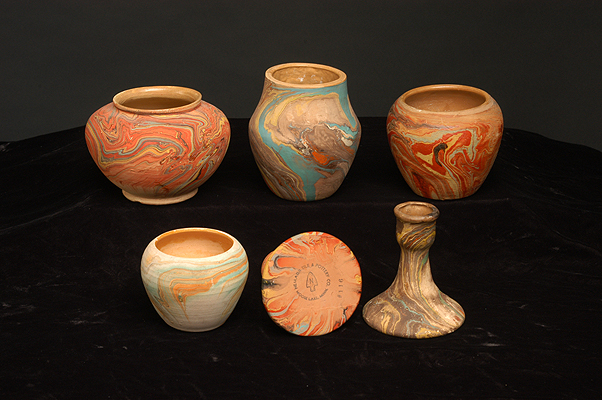
Collectors also encounter early red-clay work, Edwin Dodge pieces from the early 1940s, tiles, character mugs, anniversary pieces and occasional unmarked forms.
Eric Hellman later established Garden of the Gods Pottery in Colorado Springs. Its relationship to Nemadji makes it a fascinating companion line.
Care & collecting
For ordinary surface dirt, Michelle uses mild dish soap and a soft sponge. A delicate shellacked interior should only be wiped with a clean, soft cloth. For exterior scuffs, an artist’s eraser may help—but always test a very small area first.
Avoid soaking a piece or aggressively scrubbing painted and shellacked surfaces.